• Skip to main content
  • Skip to primary sidebar
  • Skip to footer

Fuji Lozada's Fieldnotes

  • About Fuji
    • c.v.
    • Email Me
    • Meet with Me
  • Teaching
    • Previously Taught Classes
  • Research
  • Hack College

Fuji

10 November 2012 by Fuji

YWW: Oppa Chomsky Style

NPR provided three good reasons why Britney Spears learned Gangnam Style from PSY with Ellen DeGeneres. Like other commodities that Korea produces for the world, the Korean music industry: 1) focuses on exports; 2) emphasizes the visual in music; 3) Korea is heavily wired, and knows how to leverage the internet.

“Gangnam Style” is what happens when a developing country becomes developed. An infrastructure to make and export culture can develop just like an infrastructure to make and export anything else.

NPR, Planet Money 2012

I’m going to assume that you’ve seen the original Psy video or one of the many parodies of Gangnam Style. I could have a Davidson-in-Shanghai Style video, but I lived in Seodaemun when we were in Seoul, so I’m clearly not cool enough, nor am I Noam Chomsky (@ 3:17 in the video above).
Filed Under: Youtube Worth Watching

14 June 2011 by Fuji

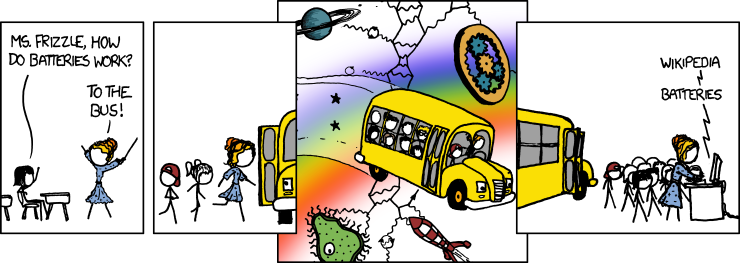
The Magic School Bus has Reached its Destination

When Wikipedia first came out, I had the typical academic response to Wikipedia – don’t use it, especially don’t cite it. I mean, how can something legitimate come out of a source that can be written by anyone with an internet connection, the same internet where no one knows that you are a dog and that has produced such phenomena as Rebecca Black, Michael Jackson-dancing inmates, and has given new life to Rick Astley.

Magic School Bus arriving at Wikipedia

Well, I was wrong. There is a lot of good stuff on Wikipedia, especially when someone is beginning to explore a topic that they either do not know anything about or they know a lot about but don’t remember exactly the exact equation or who said what. As an anthropologist, it’s second-nature to take seriously the wisdom of crowds (large or small); it’s surprising then that we would react like our academic peers in an unwillingness to acknowledge a potentially “unauthorized” source. In the end, like the knowledge that we produce through the peer-review process, Wikipedia overall is a pretty useful (and accurate) medium that reflects the conflicts, consensus, and ignorance that is part of what it means to be humans embedded in a particular social system.

I will still tell my students not to cite Wikipedia, and to rely on professional, peer-reviewed sources for their papers (where you can positively identify the source of the idea). But I will also not hesitate to tell them to check Wikipedia or to begin their exploration of a particular topic on Wikipedia. In the end, this reminds me that what we academics produce is as socially-conditioned as anything else (as science and technology studies constantly remind us), and that the peer-review process is not infallible. I’m reminded that Bernie Madoff was also peer-reviewed, and in the end was further judged by his peers in a court of law. And having Wikipedia around does not in any way diminish the importance of Ms. Frizzle to her students.

From XKCD, via Gizmodo.

Filed Under: Teaching

27 August 2010 by Fuji

Hidden values in the social sciences

As anyone who has taken at least my introduction to anthropology (and most probably any introduction to anthropology), the idea that there are hidden agendas or ideologies in social scientific analysis is not novel. In my class, we read Stephen J. Gould’s fascinating account of the early physical anthropologists to explore how subjective biases enter into seemingly objective research. It’s easy to see this problem in turn-of-the-century brain size measurer’s. It’s a lot harder to see, though, in contemporary studies that use a tremendous amount of mathematics and statistical manipulation, especially when our exposure (and attention span) is limited to the quick sound bite of new media.

I’m sure it’s still difficult for our representatives in congress to evaluate the pronouncements of academics who seek to promote a particular course of action, despite their more lengthy exposure during committee meetings and hearings – events that are accompanied by reams of text that a sane, busy person probably cannot properly fully digest.

Comic from PhD Commics on  the differences between the humanities and social sciences

In the New York Times, Princeton economist Uwe Reinhardt overviews the different ways in which “value judgments masquerade as science.” Here’s a quick take on some of the points that he makes:

The predicament of economics and all other social sciences consists in their failure to acknowledge honestly their value orientation in their pathetic and inauthentic pretension to emulate the natural sciences they presume to be value free.

Actually, this is a quote by Kim and Yoon in another publication that Reinhardt cites, but I like it. Since I am not an economist, I was unfamiliar with what he cites as a major assumption used by economists in establishing the social value of a particular economic decision – the Kaldor Hicks criterion. Reinhardt writes:

By the Kaldor-Hicks criterion, a public policy is judged to enhance economic efficiency and overall social welfare — and therefore is to be recommended by economists to decision-makers — if those who gain from the policy could potentially bribe those who lose from it into accepting it and still be better off (Kaldor), or those who lose from it were unable to bribe the gainers into forgoing the policy (Hicks). That the bribe was not paid merely underscores the point.

This appetizer of economic theory is quite intriguing, and as a social scientist who needs to talk to economists, I need to explore this some more. In this sense, economists are ahead of anthropologists (Kaldor/Hicks is from the 1930s). While we anthropologists have dealt extensively with issues of subjectivity and objectivity in our field-based research, we haven’t does as much trying to lay out particular, detailed structures that embed our values in our analysis. Instead, we try to cling to the black box of “cultural relativity.” I know that as a field we have been struggling with this issue, and have explored in more macro and philosophical terms the epistemological problems of the anthropological approach, but perhaps, like the economists, we need to risk laying out particular models that shape our thinking.

When Value Judgments Masquerade as Science, NYT

Filed Under: Anthropology, Science

6 August 2010 by Fuji

Lessons from a Royal Enfield

David Relin, the author of Three Cups of Tea, recently cited his Royal Enfield motorcycle as a source of inspiration for his efforts in writing about issues of social justice.

When Relin graduated from college, his parents gave him a life-changing gift–a ticket to any place in the world. He wanted to explore a world as opposite the US as could be, and imagined that world was India. It was a good decision, Relins says. But he followed it with a horrible one. He bought an old motorcycle, a Royal Enfield Bullet. “That bike was more like a couch than a motorcycle. It mostly just sat. It broke down constantly. Getting around with it was like trying to lug a couch.”

Soon, a pattern developed. Relin would ride his Royal Bullet until it broke down. When it did, it seemed there was always someone around willing to help him. The poorer people of India were remarkably friendly to this strange American. They often invited him into their homes, fed him and helped him fix the bike. “With a piece of tape or wire, they’d get the bike running again.”

While it’s not just motorcycles that stimulate the symbolic imaginary, there is something to the intricate practices connected to riding that provide a vivid and tangible manifestation of deeper philosophical and moral issues. I think it’s a shame that maintenance of mainstream motorcycles are increasingly placed beyond the skills and toolsets of riders, which is why I love my Royal Enfield Bullet and my Peirspeed Sachs MadAss. In his article on Relin, David Blasco reminds us of the old adage about Royal Enfields: “Turning Men into Mechanics since 1898.”

Streets of Madison, via Royal Enfield Motorcycles.

Filed Under: Anthropology, Motorcycles

7 March 2010 by Fuji

My Work as a Wordle

Fuji Lozada's Research as a Wordle

This is my research, as taken from my description of my academic work in anthropology, in word cloud format. A word cloud gives prominence to words that appear more frequently in a text (the colors and fonts are chosen for aesthetics). This was generated by a java applet written by Jonathan Feinberg.

Filed Under: Anthropology

19 January 2010 by Fuji

Keeping track of how much water China needs

China recently announced that it attends to figure out exactly how much water it has and how much it needs, according to the Wall Street Journal.

China’s water supplies are meager and dwindling, threatened by waste, pollution and chronic drought. Global warming is blamed for shrinking the big Tibetan glaciers that feed most of China’s main rivers. All this is happening just as China’s wealth is increasing demand for more water – for irrigating food, propelling hydropower, and manufacturing of all types.

Water is crucial, and with demographic and climactic changes, access to water is increasingly becoming a major source of conflict. In the past decade, whether between regions of states (as in Eastern vs. Western Washington), between states (Alabama and Georgia, South and North Carolina), or between nations, the scarcity of water has made what was once a taken-for-granted, renewable resource into a commodity that must be planned for. Our recent drought and increase in local water bills here in the Charlotte metropolitan area is part of this growing concern.

Lake Namtso in Tibet, China

Read the short WSJ report on China’s survey of water.

Filed Under: Anthropology, Environment

  • « Go to Previous Page
  • Page 1
  • Page 2
  • Page 3
  • Page 4
  • Go to Next Page »

Primary Sidebar

Fuji picture

My full name is Eriberto P. Lozada Jr. and I am the Senior Associate Dean of Faculty and Professor of Anthropology and Environmental Studies at Davidson College. As a China specialist, I teach and do research in food studies, digital studies, and media/popular culture.

Footer

Recent Posts

  • Reconstructing 20 years … 10 January 2024
  • Where I’ve been for the past five years 30 November 2018
  • Digital Persona Non Grata 25 October 2017
  • Work Smart, Not Hard: Use Zotero 1 March 2017
  • Stalking your professors using Outlook 19 October 2015

RSS feed: NYT > World > Asia Pacific NYT > World > Asia Pacific

  • Japan Mistakenly Issues Warning for Strongest Ever Earthquake
  • Deadly School Roof Collapse in Pakistan Raises Questions Over Regulation
  • Japan’s Leader Says She Loses Hours to Makeup and Chores. Opinions Abound.
  • Indonesian Stocks Plunge as MSCI Threatens to Drop Market from Indexes

RSS feed: Anthropology News Anthropology News

Copyright © 2026 · Fuji Lozada · Log in